What I Mean by "Atelier-Inspired" (and What I Don't)
Adapting a Skills-Based Approach.
1/25/20263 min read
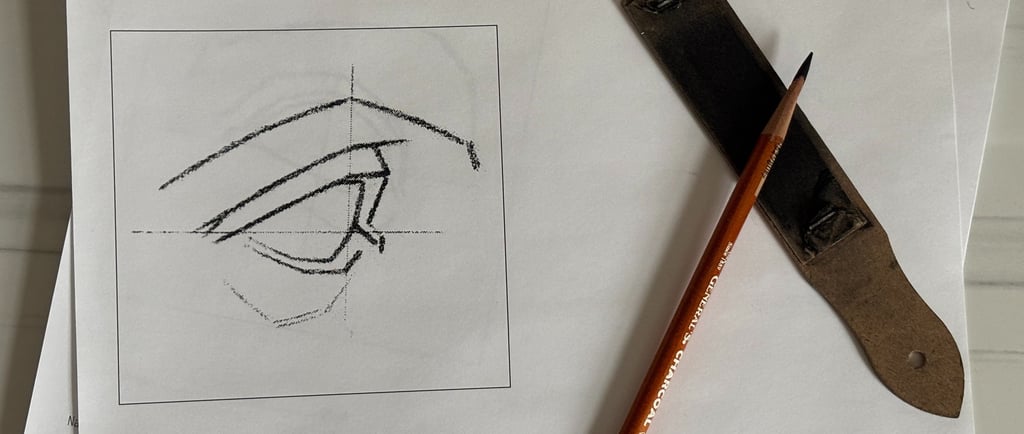
When students are given a solid foundation—one built on careful observation, disciplined practice, and well-sequenced exercises—they become more confident and more invested in their work over time.
What I Mean by “Atelier-Inspired” (and What I Don’t)
When I describe my teaching as atelier-inspired, I want to be very clear about what I mean and, just as importantly, what I don’t.
I have a deep respect for the classical atelier tradition. Through books, online programs, and classes, I rewrote my high school curriculum after years of careful observation of student outcomes. But I have not completed a formal classical atelier program. So, I don’t claim that lineage. What I do claim is something different, and in many ways more relevant to the classroom I teach in every day: thoughtful adaptation.
“Atelier-inspired” for me means borrowing what works, understanding why it works, and then reshaping it for my high school students, their schedule, and my time constraints—without watering down the fundamentals.
Respect Without Pretending
Traditional ateliers are built on conditions most high school classrooms simply don’t have:
Long, uninterrupted studio hours
Highly motivated adult students
A narrow focus on draftsmanship over months or years
One-on-one or very small group instruction
I don’t pretend I’m recreating that environment.
Instead, I ask more practical questions:
Which principles from atelier training actually move students forward ... and how can I implement them honestly in a 43-minute class with beginners?
That question guides every curricular decision I make.
What “Atelier-Inspired” Means in Practice
At its core, my approach emphasizes three classical priorities:
1. Discipline Before Expression
Before students “find their style,” they must first learn how to see.
This means:
Slowing down the drawing process
Valuing accuracy over speed
Repeating foundational exercises instead of constantly chasing novelty
In a high school setting, this discipline is not about rigidity. Rather, it’s about giving students a reliable process they can trust.
2. Fundamentals Are Non-Negotiable
An atelier-inspired mindset insists that certain skills must come before others:
Line control before shading
Value before color
Simple forms before complex subjects
Rather than jumping straight into “finished” drawings, my students spend significant time on:
Bargue Plate Recreation (to grasp proportion and develop line control)
Value scales (to understand light before rendering objects)
Basic form shading (to create space in which forms exist)
These are not glamorous exercises, but they are the ones that quietly develop student confidence.
3. Observation Is a Trainable Skill
One of the most misunderstood ideas about drawing is that it’s about talent.
An atelier-inspired approach treats observation as a skill set, not a gift.
So we deliberately practice:
Comparing angles and proportions
Measuring relationships between shapes
Noticing value shifts instead of outlining everything
Students learn that drawing is less about imagination and more about attention at this stage of their learning.
That realization alone is often transformative.
Why the Curriculum Is Structured the Way It Is
Order matters.
In traditional ateliers, exercises are sequenced very deliberately. I follow that same logic although in a shortened format.
For example:
Limited Tools Before Expanded Media
Charcoal (vine and pencil) forces students to confront mark-making, pressure sensitivity, and error management honestly.Line Control Before Form
Students develop familiarity with and control of materials to create line and moderate pressure.
Value Scales in Each Medium
Students understand how each type of charcoal affects their ability to create value differences (before applying it to objects).Simple Still Lifes Before Complex Ones
Students recreate simple geometric still lifes from a photo before moving to real-world examples.
Each exercise builds directly on the last. Nothing is assigned “just for fun.” Every exercise serves a long-term purpose.
What This Is Not
To be clear, my approach is not:
A claim to classical mastery
A rigid, museum-level training program
A rejection of creativity or personal expression
It is a foundation-first system designed to work within the realities of a high school classroom where students need structure, clarity, and visible progress.
Why I Use the Term “Atelier-Inspired”
I use the phrase “atelier-inspired” because it reflects intellectual honesty.
It acknowledges:
The influence of classical training
The limits of my teaching context
The responsibility to adapt methods thoughtfully
Most importantly, it signals to students (and parents and fellow educators) that the goal is skill development, not shortcuts.
And in my experience, when students are given a solid foundation—one built on careful observation, disciplined practice, and well-sequenced exercises—they become more confident and more invested in their work over time.
Continue the Conversation
Join the Journal
If you'd like to receive future journal entries, notes on teaching, and new work, you can join the journal below.
Respond Privately
If you'd rather respond privately to this post, you're welcome to send me a message.
© 2025 Just Go Paint
Privacy Terms Disclaimer Affiliate Disclosure
Stay Connected
Notes from the Classroom and the Easel
Want to follow along?
I write when there's something real to share—a classroom moment, a drawing session, a method that actually moved the needle. No schedule. No noise.